
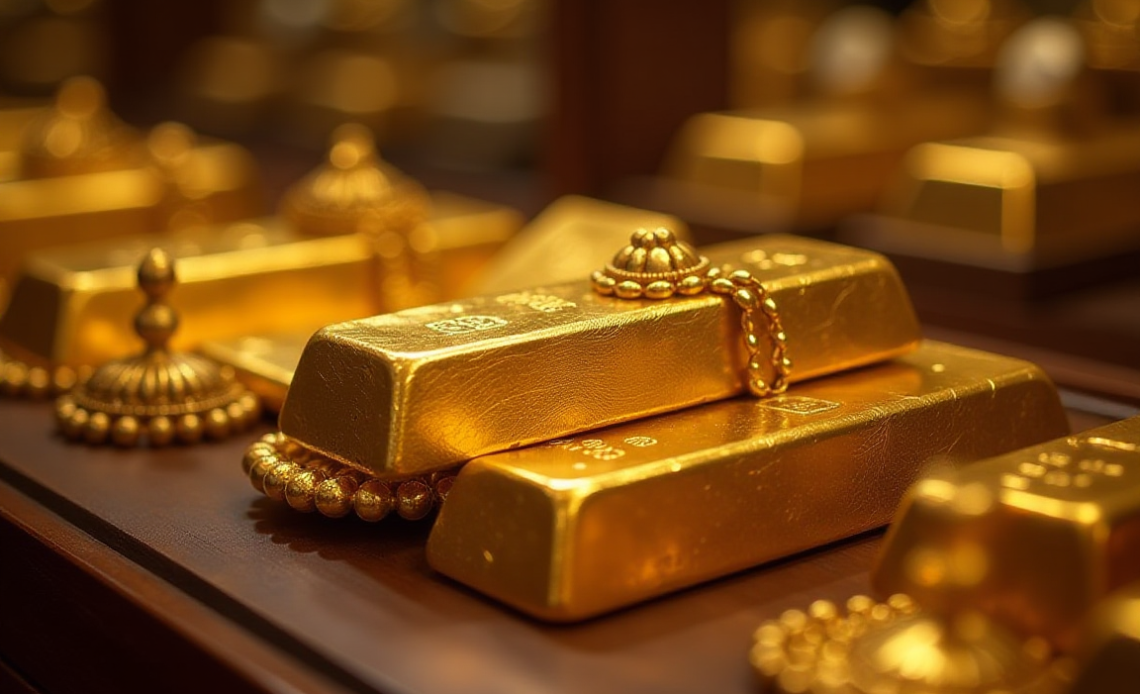
Ending the year with a stunning 66% gain, gold prices experienced their best annual performance since 1979, holding solid support above $4,300 an ounce.
With the precious metal seeing its third consecutive year of gains, one market strategist suggests there is significant potential for the unprecedented rally to continue into the new year, signaling a “tectonic shift in global financial markets,” according to Chantelle Schieven, Head of Research at Capitalight Research.
In an interview with Kitco News, Schieven explained her tectonic plate analogy by saying that although the plates in Earth’s mantle move extremely slowly, there can be an extremely explosive moment.
Gold’s explosive shift
She added that 2025 represents that explosive shift that has potentially changed the financial market landscape.
Despite increasing worries that the year’s gold rally has led the market into significantly overbought territory, Schieven cautioned investors not to mistake its current high valuation for an end to the uptrend.
She said:
Even if gold is in bubble territory, that doesn’t mean it’s going down next year — or anytime soon.
Central banks, aggressively accumulating gold reserves since 2022, are projected to remain a significant force in the market, adding value for investors through 2026, according to Schieven.
This consistent demand from the official sector provides a price floor that was absent in earlier market cycles.
Given the current market conditions, she projected that prices could “easily rise to $5,000” an ounce in the upcoming year.
Although central bank purchases will continue to be a significant support for the gold market, Schieven anticipates that investment demand will be the primary factor driving prices up to 2026.
Despite appearing to be at a high point, gold is not excessively speculative (“frothy”), according to Schieven.
She added that gold is still underrepresented in investor portfolios, especially considering the current macro risks.
Lingering uncertainty: The Federal Reserve and the challenge of inflation
The Federal Reserve concluded its last monetary policy meeting with a generally positive outlook on the economy and a projection for inflation to gradually return to its target level.
Despite this optimism, Schieven expressed doubt that inflationary pressures would dissipate as rapidly as the Fed anticipates.
She argues that fundamental structural factors—specifically deglobalisation, increased trade fragmentation, and sustained underinvestment in commodities—are inherently inflationary forces that will persist.
Higher inflation, according to Schieven, makes the traditional safe-haven role of bonds more complex.
Consequently, investors who have experienced negative real returns are increasingly seeing gold not just as a speculative hedge but as a crucial portfolio diversifier.
The Fed is optimistically forecasting — on a hope and a prayer — that inflation comes down.
Bonds are no longer perceived as a reliably safe investment, particularly if inflation proves more persistent than central bankers anticipate, Schieven said.
For investors who believe inflation will remain elevated, purchasing bonds currently may not be a favorable decision, she added.
Schieven also highlighted subtle yet significant changes in Fed policy, such as balance-sheet adjustments aimed at capping bond yields.
While these steps might offer a temporary solution, they do little to rebuild faith in long-term monetary stability—a factor that further boosts the appeal of gold.
Schieven maintains a bullish perspective, suggesting that $5,000 is a feasible goal for the upcoming year. She views this target as potentially just another short-term milestone within a broader, extended upward trend.
While the long-term trend remains positive, Schieven anticipates that relative volatility will be high, leading to constructive and healthy market corrections.
The post Gold’s “tectonic shift”: analyst projects $5,000 price target amid persistent inflation appeared first on Invezz